


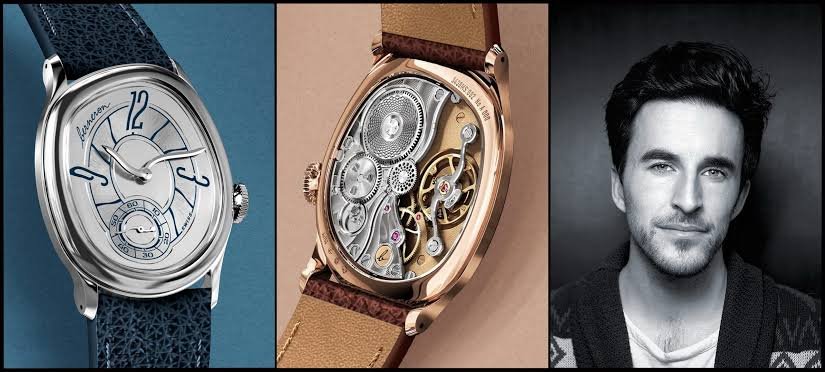
Sylvain Berneron is an independent watchmaker who is attracting attention for a very different approach to luxury watch design. Instead of following the familiar round case shapes that dominate traditional mechanical watches, Berneron explores unusual geometry, sculptural cases, and movement designs that are closely connected to the shape of the watch.
His work represents a new direction in independent watchmaking: creating timepieces where the movement, case, finishing, and visual identity are designed as one complete object.
Who Is Sylvain Berneron?
Sylvain Berneron is a French independent watchmaker and designer known for creating highly distinctive mechanical watches. Before establishing his own name in independent watchmaking, he gained experience in the Swiss luxury watch industry, including work related to product development and design.
That professional background helped him understand traditional watchmaking from the inside. His independent work, however, gives him the freedom to question many of the industry’s usual design rules.
Berneron’s watches are not designed simply to look different. Their unusual shapes are connected to the architecture of the movement and the way the watch is intended to be experienced on the wrist.
Why Is Sylvain Berneron Challenging Traditional Geometry?
Traditional mechanical watches often use round cases because the shape is practical, familiar, and historically established. Berneron takes a different path.
His approach explores asymmetry, curves, and more complex three-dimensional forms. The case can appear almost like a piece of modern sculpture rather than a conventional watch.
This creates an important design question: Why should a mechanical watch always be round?
For Berneron, there is no strong reason to follow that rule simply because it has existed for generations.
His philosophy is based on designing the watch from the inside out. Instead of creating a standard case and then placing a movement inside it, the movement and case can be developed together.
The Birth of Berneron’s Independent Watch Brand
Berneron launched his own independent watchmaking venture to pursue ideas that are difficult to execute within a large traditional watch company.
Independent watchmakers generally have more freedom to experiment with materials, movement architecture, finishing, and case design. However, they also face much greater challenges because production volumes are small and every component requires significant development.
This makes Berneron’s work particularly interesting to collectors who value originality over mass recognition.
His watches are produced in very limited quantities, reinforcing their position within the world of independent haute horlogerie.
The Mirage Collection
One of the most important names associated with Berneron’s work is Mirage.
The Mirage collection is designed around an unusual case architecture that immediately separates it from conventional luxury watches. Its flowing, sculptural shape is one of its defining characteristics.
The watch does not look like a standard round timepiece with decorative details added afterward. Instead, the entire object has a strong architectural identity.
This approach gives the watch a futuristic appearance while still retaining the traditional mechanical craftsmanship expected from high-end Swiss watchmaking.
A Movement Designed for the Case
One of the most interesting aspects of Berneron’s philosophy is the relationship between the movement and the case.
In conventional watchmaking, movements are often designed around established dimensions so they can fit into different cases or product families. Berneron’s approach is much more integrated.
The movement architecture helps support the unusual visual identity of the watch.
This is important because unusual geometry is not easy to achieve mechanically. A complex case can create challenges involving manufacturing, finishing, assembly, water resistance, ergonomics, and movement construction.
By treating these elements as connected problems, Berneron creates a watch that feels coherent rather than simply unconventional.
Why Collectors Are Interested in Berneron’s Watches
Independent watch collectors often look for something beyond brand prestige. They may be interested in craftsmanship, rarity, technical innovation, artistic expression, and the story behind a watch.
Berneron’s work combines several of these qualities.
First, production is extremely limited compared with mainstream luxury brands. Second, the designs are immediately recognizable. Third, the watches demonstrate a strong connection between artistic design and mechanical engineering.
For collectors, this can make a Berneron timepiece more than a device for telling time. It becomes an example of contemporary mechanical art.
Traditional Craftsmanship Meets Modern Design
Although Berneron’s watches look modern, they are deeply connected to traditional watchmaking.
Mechanical watchmaking depends on skills such as hand finishing, polishing, machining, movement assembly, and precision adjustment. These techniques have developed over centuries.
Berneron’s contribution is not about abandoning those traditions. Instead, he uses them to create something that looks less traditional.
This combination is one reason independent watchmakers are important to the modern luxury-watch industry. They can preserve traditional mechanical skills while exploring new forms.
What Makes Independent Watchmaking Different?
Large watch companies have significant resources, global distribution networks, and established manufacturing systems. These advantages allow them to produce thousands or even millions of watches.
An independent watchmaker works on a completely different scale.
A small independent brand may have to develop movements, source specialized components, manage suppliers, oversee finishing, and communicate directly with collectors.
The result can be more personal and experimental.
For someone like Berneron, independence provides the creative freedom to ask fundamental questions about watch design.
The Future of Watch Design
Berneron’s work reflects a broader change in luxury watchmaking.
Modern collectors are increasingly interested in independent creators who offer designs that cannot easily be confused with mainstream products. The growth of independent watchmaking has created a space for unusual ideas, experimental movements, and artistic approaches.
This does not mean traditional round watches will disappear. Classic designs remain extremely popular.
Instead, watchmaking is becoming more diverse.
Berneron represents one part of that movement. His approach suggests that the future of mechanical watches may not be about making traditional designs slightly different. It may involve completely reconsidering how a watch should be shaped and constructed.
Why Sylvain Berneron Matters
Sylvain Berneron’s importance comes from his willingness to question established design conventions.
He demonstrates that mechanical watches can be treated as objects of architecture and sculpture while still respecting the technical discipline of horology.
His work also highlights the value of independent watchmakers in an industry dominated by large luxury groups.
By combining unusual geometry, movement development, traditional finishing, and contemporary design, Berneron has created a distinctive identity in a crowded luxury-watch market.
For watch enthusiasts, his work offers an interesting question: What happens when a watchmaker stops asking what a traditional watch should look like and starts designing what a mechanical watch could become?
That question is at the heart of Sylvain Berneron’s appeal.
Conclusion
Sylvain Berneron represents a fascinating side of modern independent watchmaking. His work does not simply decorate traditional watches with unusual shapes. Instead, it questions the relationship between geometry, movement, engineering, and artistic design.
By challenging the idea that a mechanical watch must follow familiar proportions, Berneron has created a distinctive voice in contemporary horology. His approach shows that traditional craftsmanship and radical design can exist together.
As collectors continue to search for originality and independent watchmakers gain greater recognition, Sylvain Berneron’s work is likely to remain an important example of how traditional horology can evolve without losing its mechanical soul.
