


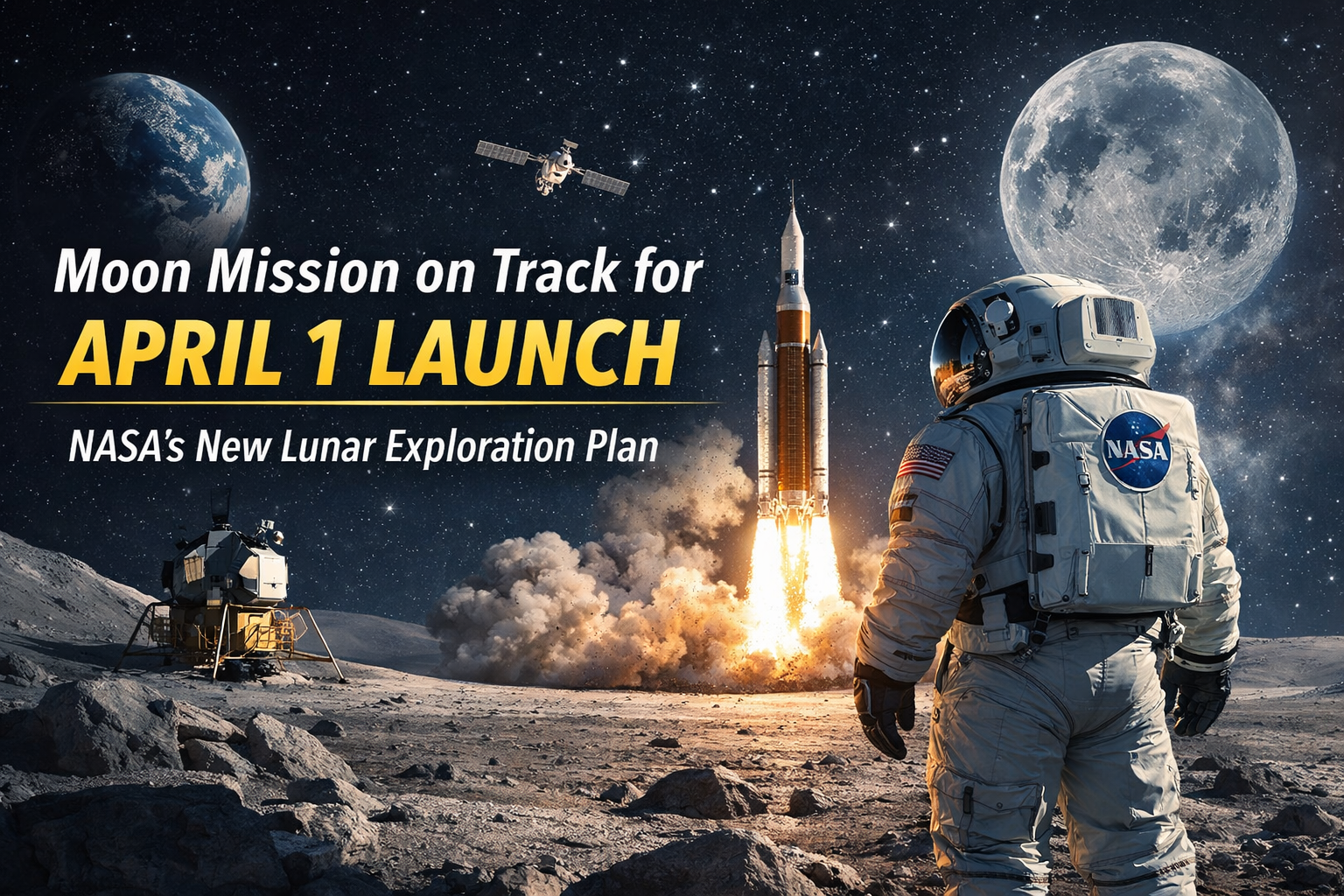
Space exploration continues to inspire people around the world, and NASA’s upcoming Moon mission scheduled for April 1 is creating a lot of excitement. This mission represents another important step in humanity’s return to the Moon and the preparation for future missions to Mars.
NASA has been working for several years on advanced technologies, spacecraft systems, and astronaut training to make this mission successful. The goal is not only to explore the Moon again but also to build a long-term presence there that will help scientists learn more about space, technology, and the future of human exploration.
In this article, we will explain the April 1 Moon mission, its objectives, technology, importance, and what it means for the future of space travel.
NASA’s Vision for Returning to the Moon
NASA’s current lunar exploration program aims to return humans to the Moon after more than five decades. The last time astronauts walked on the Moon was during the Apollo missions in the 1960s and 1970s.
Today, NASA’s new mission is part of a larger plan to:
- Send astronauts back to the Moon
- Build a sustainable lunar base
- Develop technology for future Mars missions
- Encourage international cooperation in space exploration
The upcoming April 1 launch is an important part of this long-term strategy.
Why the April 1 Moon Mission Matters
The April 1 Moon mission is more than just another rocket launch. It plays a key role in preparing for future human missions to the Moon.
Key Reasons the Mission Is Important
1. Testing New Space Technologies
NASA will test new spacecraft systems, navigation tools, and communication technologies that are essential for deep space missions.
2. Preparing for Astronaut Missions
This mission helps NASA understand how equipment performs in space before sending astronauts on future missions.
3. Scientific Research
The Moon still holds many mysteries. Scientists want to learn more about its surface, water resources, and geological history.
4. Building Infrastructure for the Future
NASA is planning to create a long-term lunar presence, including possible lunar bases and research stations.
The Technology Behind the Mission
Modern space missions rely on advanced technology. NASA’s Moon mission will use several innovative systems designed to improve safety, efficiency, and mission success.
Advanced Launch Vehicles
Powerful rockets are required to send spacecraft beyond Earth’s orbit. These rockets are designed to carry heavy payloads and travel long distances.
Lunar Landing Systems
Landing on the Moon requires precise navigation and advanced landing technology. NASA has developed improved systems to ensure safe and accurate lunar landings.
Deep Space Communication
Communication between Earth and spacecraft becomes more challenging as distance increases. NASA uses powerful antennas and satellites to maintain constant contact.
Navigation and Autonomous Systems
Modern spacecraft can navigate using automated systems that allow them to make adjustments during the journey.
Mission Objectives
The April 1 Moon mission has several important objectives.
1. Lunar Surface Exploration
One of the main goals is to study the Moon’s surface in greater detail. Scientists want to learn more about:
- Lunar soil composition
- Surface temperature
- Geological features
These studies help scientists understand how the Moon formed and evolved.
2. Water Ice Investigation
Recent discoveries suggest that water ice may exist near the Moon’s poles. This could be extremely valuable for future missions.
Water on the Moon could potentially be used for:
- Drinking water for astronauts
- Oxygen production
- Rocket fuel
Finding accessible water sources would make long-term lunar missions much easier.
3. Technology Demonstration
NASA will also test new equipment and technologies that could be used in future missions, including:
- Autonomous navigation systems
- Lunar landing technologies
- Surface mobility systems
Successful testing will help improve future space missions.
International Collaboration in Lunar Exploration
Space exploration is no longer limited to one country. Many international partners are working with NASA to explore the Moon.
Countries and organizations contributing to lunar missions include:
- European Space Agency (ESA)
- Japan Aerospace Exploration Agency (JAXA)
- Canadian Space Agency (CSA)
- Private aerospace companies
These partnerships allow scientists and engineers from around the world to work together and share knowledge.
Private Companies Playing a Role
In recent years, private space companies have become important partners in space exploration.
NASA collaborates with commercial partners to:
- Develop spacecraft systems
- Launch satellites and cargo
- Deliver scientific equipment to the Moon
These partnerships help reduce costs and accelerate technological innovation.
Preparing for Future Human Missions
The April 1 launch is an important step toward sending astronauts back to the Moon.
Future missions aim to:
- Establish long-term lunar habitats
- Conduct extended scientific research
- Test life-support systems
- Prepare astronauts for deep space travel
Lessons learned from robotic missions help ensure that future astronaut missions are safe and successful.
The Road to Mars
NASA’s Moon exploration program is also connected to its long-term goal of sending humans to Mars.
The Moon provides an ideal testing ground for:
- Space habitats
- Resource utilization
- Deep space travel technologies
- Long-duration astronaut missions
By learning how to operate on the Moon, NASA can develop the skills needed for future missions to Mars.
Inspiring the Next Generation
Space missions have always inspired students, scientists, and dreamers around the world.
NASA’s Moon mission encourages young people to pursue careers in:
- Science
- Engineering
- Technology
- Astronomy
- Space research
Educational programs and public outreach events allow students to learn more about space exploration and participate in exciting projects.
Challenges of Lunar Missions
Despite the excitement, lunar missions are extremely complex and require careful planning.
Some major challenges include:
- Extreme temperatures on the Moon
- Communication delays
- Space radiation exposure
- Precise navigation requirements
NASA engineers spend years designing systems to overcome these challenges.
What Happens After the Launch
After the April 1 launch, the mission will go through several phases:
1. Launch and Earth Orbit
The rocket will first place the spacecraft into Earth orbit before sending it toward the Moon.
2. Lunar Transfer
The spacecraft will travel through deep space toward the Moon.
3. Lunar Orbit
Once near the Moon, the spacecraft will enter lunar orbit.
4. Surface Operations
Scientific instruments will begin collecting valuable data about the Moon.
The Future of Lunar Exploration
The April 1 Moon mission is just one step in a long journey. Over the next decade, NASA plans to conduct multiple missions that will gradually expand human activity on the Moon.
Future plans include:
- Lunar research stations
- Regular astronaut missions
- Commercial lunar transportation
- Deep space exploration programs
These missions will help humanity explore the solar system and unlock new scientific discoveries.
Conclusion
NASA’s Moon Mission scheduled for April 1 represents a major milestone in the future of space exploration. By testing advanced technology, studying lunar resources, and preparing for human missions, NASA is laying the foundation for a new era of discovery.
The mission not only brings humanity closer to returning to the Moon but also moves us one step closer to exploring Mars and beyond.
As technology continues to evolve and international partnerships grow stronger, the dream of long-term human presence on the Moon is becoming more realistic than ever.
FAQs
1. What is the purpose of NASA’s April 1 Moon mission?
The mission aims to test new space technologies, conduct scientific research, and prepare for future human missions to the Moon.
2. Will astronauts be on this mission?
Most early lunar missions are robotic. They help test systems before astronauts are sent to the Moon.
3. Why is NASA returning to the Moon?
NASA wants to study the Moon in greater detail and prepare for future missions to Mars.
4. How long does it take to travel from Earth to the Moon?
A spacecraft usually takes about 3 to 5 days to travel from Earth to the Moon.
5. What will scientists study during the mission?
Scientists will study the Moon’s surface, geological features, and possible water resources.
