


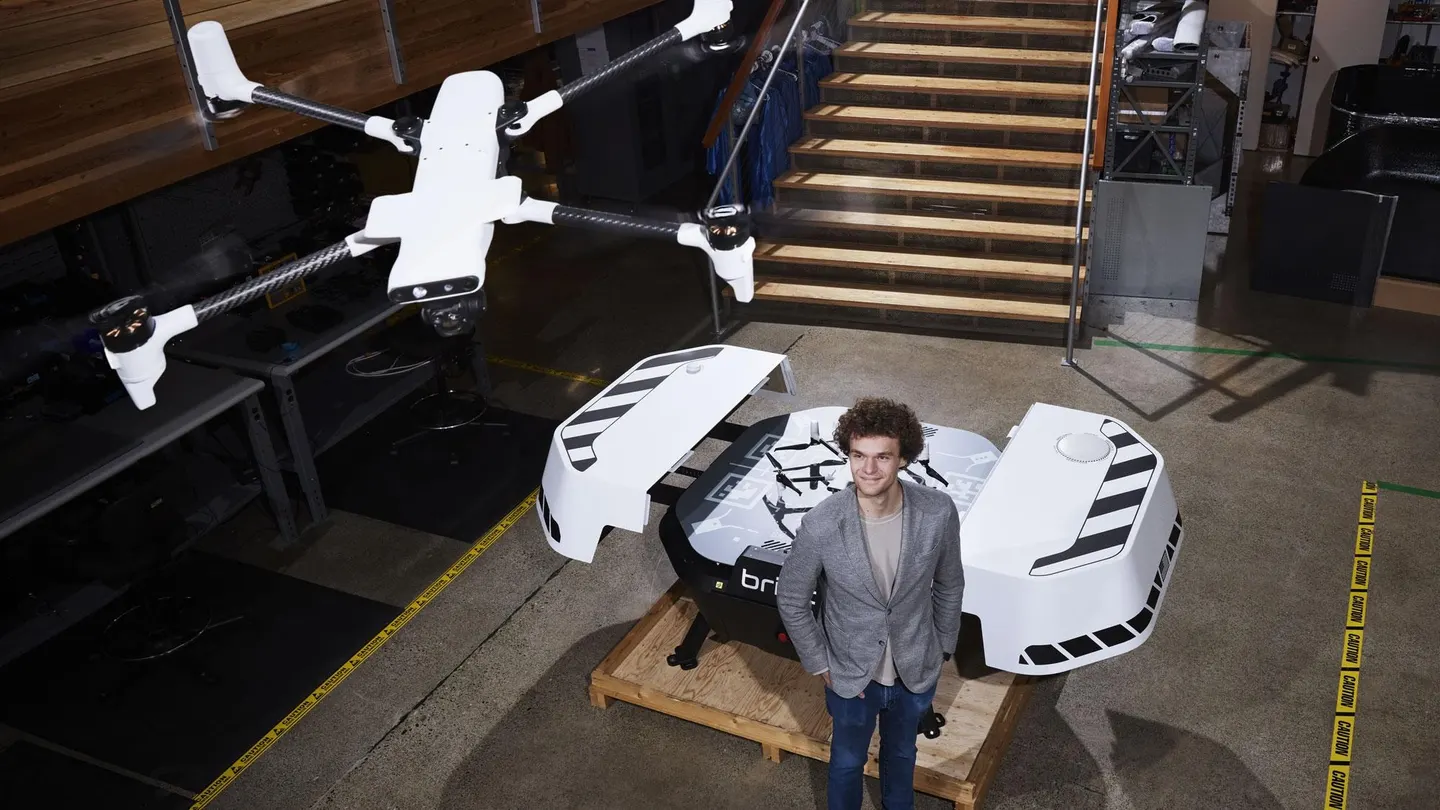
When Blake Resnick told his parents he was dropping out of college to build drones, the reaction was exactly what you’d expect. Seven years later, more than 700 police departments use his technology, his company is valued at nearly half a billion dollars, and he jokes that his mother has finally forgiven him.
Resnick, now 25, is the founder and CEO of Brinc, one of the few U.S.-based drone companies attempting to compete head-on with Chinese giant DJI. It’s a mission that sits at the intersection of technology, geopolitics, public safety, and national security—and one that Resnick has pursued with unusual focus for someone who started before he could legally vote.
A Crisis That Sparked an Obsession
Brinc’s origin story traces back to October 2017. Resnick was 17 and living in Las Vegas when a mass shooting unfolded just miles from his home. As police struggled to assess the situation, Resnick—who had been building drones since childhood—couldn’t understand why unmanned aircraft weren’t being used to gather intelligence safely.
He didn’t tweet about it. He didn’t write a think piece. He called the police department.
That call led to a meeting with a skeptical SWAT lieutenant who gave Resnick 90 days to build something useful. His first prototype failed spectacularly. An officer knocked it out of the air with a towel.
Resnick went back to work.
From Dining Table Prototype to Police Tool
Three months later, he returned with a drone that could right itself after being shoved to the ground. That second demo changed everything. Police invited Resnick on ride-alongs, and together they built what became Brinc’s first flagship product: the Lemur, a drone designed for indoor SWAT operations.
Brinc officially incorporated in 2018. For two years, Resnick was the company.
The National Security Opportunity
Today, China manufactures roughly 70% of the world’s drones, and DJI dominates public safety fleets in the U.S. Over 80% of American police departments that use drones rely on DJI devices.
Resnick believes that’s a problem.
“I don’t think it’s healthy that the free world controls less than 5% of the global drone market,” he says. His goal is blunt: build “the DJI of the West.”
That argument has gained traction in Washington. Unless U.S. intelligence agencies certify DJI as secure, its drones face a future ban from American government use—a regulatory shift that could fundamentally reshape the market.
Resnick hasn’t been a bystander. Brinc has spent more than $600,000 lobbying for restrictions on Chinese-made drones. It’s a bold move for a company that is still unprofitable, but the upside is enormous.
The Responder and Real-World Impact
Brinc’s most ambitious product is the Responder, a drone-in-a-box system designed for 911 calls. Stored in rooftop charging docks, the drones can launch autonomously and reach emergencies within minutes—often before officers arrive.
In Queen Creek, Arizona, a single Responder drone has been deployed more than 450 times in under a year, including burglaries, assaults, and shots-fired calls. In dozens of cases, the drone resolved situations without officers ever making contact.
That capability—speed without escalation—is what sells police chiefs.
Funding, Credibility, and Silicon Valley Backing
Brinc’s credibility accelerated when Sam Altman invested in 2020. A $2 million check opened doors. Soon after came funding from Peter Thiel, Index Ventures, Motorola, and others.
To date, Brinc has raised $157 million and reached a $480 million valuation. Resnick owns roughly 40% of the company.
Not Without Critics
Brinc’s drones aren’t universally loved. Some police pilots argue DJI devices are still superior—more reliable, more refined, and cheaper. Others point to Skydio as a formidable domestic competitor with deeper government penetration.
Resnick doesn’t deny the gap. “DJI makes incredible products at very low prices,” he admits. His bet is that geopolitics, not specs alone, will determine the future.
A Founder With Long-Term Conviction
Resnick spends much of his time traveling, pitching police departments and city officials. He’s less interested in quick wins than in structural change.
After Russia invaded Ukraine, Brinc sent drones to Kyiv to support search-and-rescue missions. Defense contracts may follow, but Resnick insists democracy—not defense revenue—is his motivator.
“I care about democracy existing,” he says.
The Bottom Line
Brinc is still early. It’s not the market leader. It’s not the cheapest. And it’s not yet profitable.
But Resnick understands something many founders miss: when technology intersects with national policy, markets can change fast.
If Chinese drones are sidelined, Brinc won’t need to be perfect. It will need to be ready.
And Blake Resnick, by every measure, already is.
