


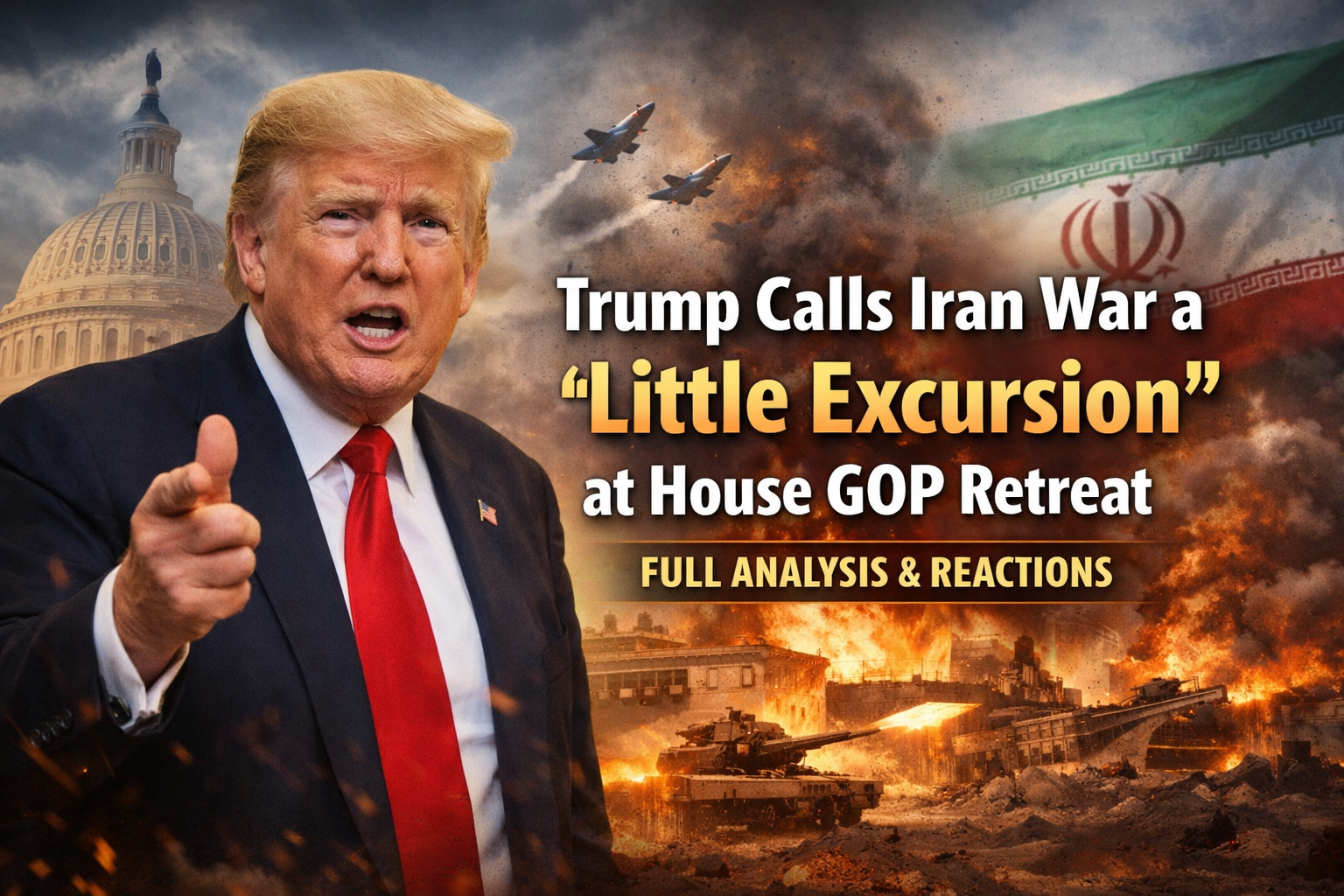
The ongoing conflict between the United States and Iran has become one of the most discussed global political developments. During a House Republican retreat in Florida, Donald Trump made headlines after describing the war with Iran as a “little excursion.” His remarks quickly sparked debate across political circles, media outlets, and international observers.
The statement came at a time when tensions in the Middle East remain high and military operations continue to unfold. While Trump suggested that the United States has already achieved significant success in the conflict, critics argue that describing a war in such terms may minimize its human and economic impact.
This article explains the context of Trump’s comments, the current status of the war, political reactions, and the possible implications for global stability.
Background of the US-Iran Conflict
The conflict between the United States and Iran has deep historical roots. For decades, relations between the two countries have been strained due to geopolitical disagreements, nuclear concerns, and regional influence in the Middle East.
Recent tensions escalated after joint military operations involving the United States and Israel targeted Iranian military infrastructure. The campaign, referred to by U.S. officials as Operation Epic Fury, aimed to weaken Iran’s missile systems and drone capabilities.
According to reports, U.S. strikes have destroyed a large portion of Iran’s military assets, including missile launchers and naval equipment. However, the situation remains volatile as Iran continues to respond with attacks across the region.
The war has already resulted in casualties on multiple sides, including American soldiers and civilians in affected areas.
Trump’s “Little Excursion” Comment Explained
During a policy retreat attended by Republican lawmakers in Florida, Donald Trump addressed the ongoing war. He described the military campaign as a short-term mission designed to remove threats posed by Iran.
Trump said the United States had taken a “little excursion” into the Middle East to “get rid of some evil,” suggesting that the operation was necessary to neutralize potential dangers.
He also told lawmakers that the United States had already achieved major victories against Iran’s military infrastructure but emphasized that the broader mission was not yet complete.
While some supporters interpreted the phrase as a way to highlight the success of U.S. military operations, critics argued that calling a war a “little excursion” might downplay the seriousness of the conflict.
Military Progress Claimed by the Administration
During the same remarks, Trump highlighted several achievements of the U.S. military campaign against Iran.
According to the administration:
- More than 90% of Iran’s missile launchers have been destroyed.
- Around 80% of drone launch systems have been eliminated.
- Iranian naval assets have suffered significant losses.
- Strategic military bases used by Iran have been targeted.
Trump suggested that the operation was ahead of schedule and that the United States had already weakened Iran’s ability to launch large-scale attacks.
However, military analysts caution that such conflicts are often unpredictable and that Iran still possesses capabilities to retaliate.
Human Cost of the Conflict
Despite political discussions about strategy and success, the war has had a significant human cost.
Several American service members have been killed during the conflict, including soldiers stationed at military bases in the region. Families of those soldiers have called for the war to achieve meaningful results.
Trump referenced meeting with the families of fallen soldiers at a military base in Delaware, saying they urged him to ensure that the mission succeeds.
Beyond military casualties, the conflict has also affected civilians in various parts of the Middle East. Airstrikes, missile attacks, and disruptions to infrastructure have led to displacement and humanitarian concerns.
The growing number of casualties has increased calls from international organizations for diplomatic solutions.
Economic Impact of the War
Another major concern surrounding the US-Iran war is its effect on the global economy.
The Middle East is a key region for global oil production. Whenever conflict escalates there, energy markets often react immediately.
Since the start of the war:
- Oil prices have risen sharply.
- Shipping routes in the Persian Gulf face higher security risks.
- Global markets have shown increased volatility.
Trump downplayed the economic consequences during his remarks, saying that rising oil prices would not significantly affect the United States.
However, economists warn that prolonged conflict could lead to inflation, supply chain disruptions, and higher fuel costs worldwide.
Political Reactions in Washington
Trump’s “little excursion” comment triggered mixed reactions among American politicians.
Republican Response
Many Republican lawmakers at the retreat applauded Trump’s comments and supported the military campaign against Iran.
They argued that decisive action was necessary to prevent Iran from threatening American troops, allies, and global shipping routes.
Democratic Response
Several Democratic leaders criticized the administration’s language and strategy.
Some argued that Congress had not fully debated the decision to escalate military operations and warned that the conflict could expand into a larger regional war.
Others expressed concern that describing the war in casual terms might undermine the seriousness of the situation.
International Reactions
International leaders and analysts also reacted strongly to Trump’s remarks.
Middle Eastern Countries
Countries in the Middle East remain divided.
Some governments support U.S. efforts to weaken Iran’s military influence, while others fear that the war could destabilize the entire region.
Global Powers
Major global powers including China, Russia, and European nations have called for restraint and diplomatic negotiations.
Many leaders worry that continued escalation could lead to a broader international conflict.
Unclear War Objectives
One major criticism of the current strategy is the lack of clearly defined goals.
While the administration claims the war aims to weaken Iran’s military capabilities, some analysts say the long-term objectives remain unclear.
Possible goals include:
- Preventing Iran from developing nuclear weapons
- Limiting Iran’s influence in the Middle East
- Protecting U.S. allies in the region
- Regime change in Iran
Without a clear strategy, experts warn that the conflict could continue longer than expected.
Could the War End Soon?
Trump has suggested that the war may end soon because Iran’s military capabilities have already been severely damaged.
However, defense officials say conflicts of this scale rarely end quickly.
Iran still maintains regional alliances and influence across several countries, including Iraq, Syria, and Lebanon.
Even if major military operations slow down, tensions between the United States and Iran could continue for years.
What This Means for Global Politics
The US-Iran war has major implications for global geopolitics.
If the conflict continues, it could reshape alliances in the Middle East and influence international energy markets.
It may also affect upcoming elections in the United States, as voters debate the costs and benefits of military intervention.
Trump’s comments about the war being a “little excursion” have therefore become more than just a political soundbite—they highlight the broader debate about America’s role in global conflicts.
Conclusion
Donald Trump’s description of the Iran war as a “little excursion” has sparked significant discussion in political and international circles. While the administration argues that the military campaign has achieved major progress, critics say the conflict’s consequences should not be minimized.
The war continues to affect soldiers, civilians, economies, and global diplomacy. Whether the conflict ends soon or evolves into a longer struggle will depend on military developments, diplomatic negotiations, and decisions made by leaders on all sides.
As the situation unfolds, the world will closely watch how the United States, Iran, and their allies respond to the ongoing crisis.
FAQs
1. Why did Donald Trump call the Iran war a “little excursion”?
Trump used the phrase during a House Republican retreat to describe the U.S. military operation against Iran, suggesting it was a short-term mission to remove threats.
2. What is Operation Epic Fury?
Operation Epic Fury is the name used by U.S. officials for the military campaign targeting Iran’s missile and drone capabilities.
3. Has the United States defeated Iran in the war?
Trump claimed the U.S. has already achieved major victories, but the conflict is still ongoing and its final outcome remains uncertain.
4. How has the war affected global oil prices?
The conflict has pushed oil prices higher due to concerns about supply disruptions in the Middle East.
5. Could the US-Iran war expand further?
Yes. Analysts warn that if tensions escalate, the conflict could involve more countries and become a wider regional war.
