


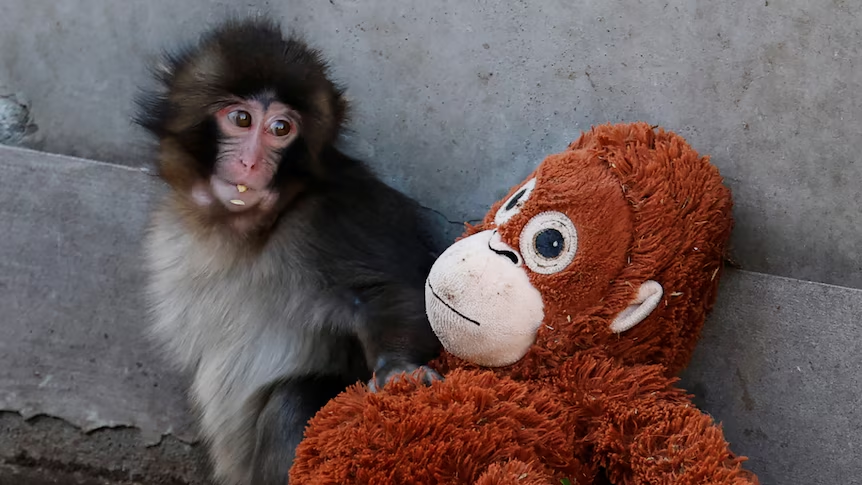
In a world where viral trends appear and disappear almost instantly, a small baby monkey named Punch managed to capture global attention in a way few stories do. What began as a simple moment at a Japanese zoo soon turned into an emotional viral phenomenon shared across social media platforms worldwide. Punch’s story, centered around resilience, loneliness, and comfort, quickly resonated with millions of people who saw a piece of their own emotions reflected in the tiny animal.
Punch is a Japanese macaque born at the Ichikawa City Zoo in Chiba, Japan. Japanese macaques, often referred to as snow monkeys, are known for their intelligence and strong social bonds. Normally, infant monkeys spend their early months clinging closely to their mothers, learning essential behaviors and finding comfort through physical contact.
However, Punch’s start in life was not typical.
Shortly after he was born, Punch was abandoned by his mother. For baby primates, maternal care is extremely important for survival and emotional development. Without his mother’s support, Punch faced a vulnerable beginning. Zoo caretakers had to step in to provide the care he needed, feeding him and ensuring he stayed healthy during the early stages of his life.
But there was still one problem: emotional comfort.
Young monkeys instinctively cling to their mothers’ bodies for warmth and security. Without that physical connection, Punch showed signs of stress and loneliness. To help ease his anxiety, zookeepers introduced a soft stuffed toy into his enclosure. The toy, an orangutan plush, was meant to give the baby monkey something soft to hold onto.
The result was unexpectedly touching.
Videos began circulating online showing Punch tightly hugging the plush toy, carrying it around the enclosure, and even resting against it while sleeping. In one particularly emotional clip that quickly went viral, Punch appeared to run toward the stuffed toy after another monkey pushed him away.
The moment struck a chord with viewers everywhere.
Within days, the videos spread rapidly across platforms like TikTok, Instagram, and X. Millions of people watched the tiny monkey cling to the toy as if it were his surrogate mother. Comments flooded social media, with many viewers expressing sympathy for Punch and admiration for the zoo staff who tried to comfort him.
People began referring to the toy affectionately as Punch’s “adopted mother.”
The emotional power of the story made it different from typical viral animal clips. Instead of simply being cute or funny, Punch’s behavior reflected something deeply relatable: the universal need for comfort, companionship, and emotional security.
Psychologists often note that humans naturally project their own emotions onto animals. When animals display behaviors that resemble human feelings—such as loneliness, affection, or sadness—it creates a powerful emotional connection. Punch’s attachment to the stuffed toy felt heartbreakingly familiar to many people who saw it.
The viral attention had real-world effects as well.
Ichikawa City Zoo experienced a noticeable surge in visitors as people traveled to see Punch in person. Many wanted to witness the tiny monkey and his beloved plush companion firsthand. Because of the crowds gathering near the enclosure, zoo staff eventually had to limit viewing times to ensure everyone had a chance to see him.
Another unexpected result of Punch’s fame was the sudden popularity of the stuffed toy itself. Online users quickly identified the plush orangutan as a toy similar to one sold by IKEA. As Punch’s story continued spreading, demand for the toy increased dramatically, and it reportedly sold out in several locations.
But beyond internet fame and merchandise trends, the most important part of Punch’s story is his gradual recovery and development.
Over time, caretakers encouraged interactions between Punch and other monkeys in the enclosure. Social interaction is critical for young macaques because they learn important behaviors through play and grooming within the troop.
Recent updates from observers suggest that Punch has slowly begun to integrate with the other monkeys. Videos now show him climbing, playing, and exploring alongside young members of the group. In some cases, adult monkeys have even been seen grooming him—a sign of social acceptance in macaque communities.
While he still appears attached to the stuffed toy that comforted him early in life, Punch’s increasing confidence suggests that he is beginning to find his place within the troop.
For many people who followed the viral story, this development is incredibly reassuring. What began as a heartbreaking story about abandonment has gradually become one about adaptation and resilience.
Punch’s journey reminds us that even small acts of care can make a significant difference. The simple decision by zoo staff to place a soft toy in the enclosure provided the baby monkey with comfort during a vulnerable time.
And in the process, that small moment touched millions of people around the world.
The internet often moves quickly from one trend to another, but stories like Punch’s endure because they reveal something universal about life. Whether human or animal, every creature seeks connection, safety, and belonging.
Punch may only be a small monkey in a zoo enclosure, but his story carries a message far bigger than himself: even in moments of loneliness, compassion and support can help us find our way forward.
