


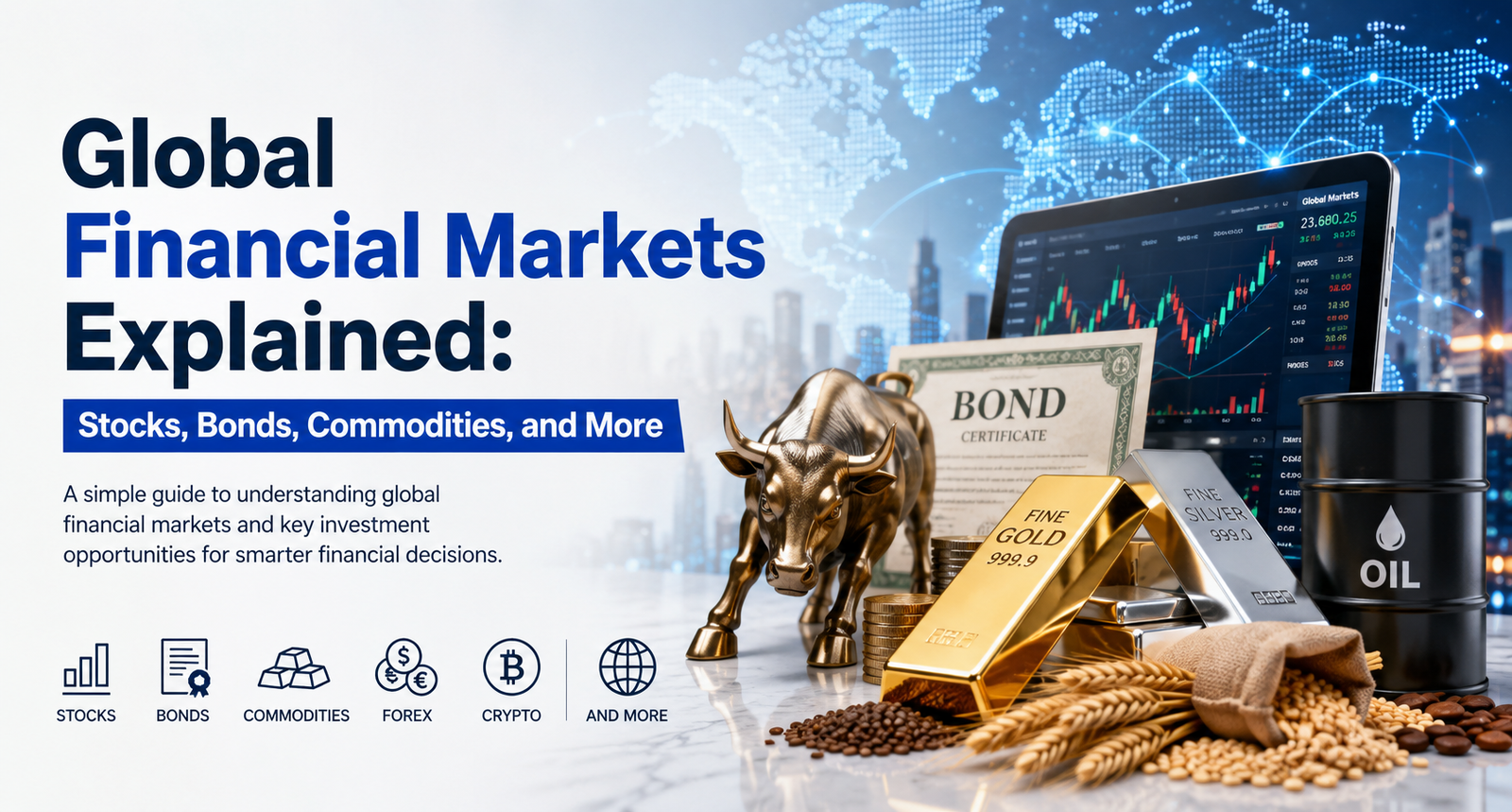
Financial markets play a major role in the global economy. They help businesses raise money, allow governments to fund projects, and give investors opportunities to grow their wealth. Whether you are a beginner or an experienced investor, understanding how financial markets work can help you make better financial decisions.
In this guide, we will explain the main types of global financial markets, including stocks, bonds, commodities, and other important investment options.
What Are Financial Markets?
Financial markets are places where buyers and sellers trade financial assets. These markets connect people who need money with those who want to invest their money for potential returns.
Financial markets help:
- Businesses raise capital
- Governments borrow funds
- Investors build wealth
- Economies grow and develop
Today, most financial market transactions happen online through exchanges and trading platforms around the world.
Understanding the Stock Market
The stock market is one of the most popular financial markets. It allows investors to buy and sell shares of publicly traded companies.
When you purchase a stock, you become a small owner of that company. If the company performs well, the value of your shares may increase.
Benefits of Investing in Stocks
- Potential for long-term growth
- Dividend income from some companies
- Easy access through online brokers
- Opportunity to invest in leading global businesses
Risks of Investing in Stocks
- Market volatility
- Economic downturns
- Company-specific risks
- Changes in investor sentiment
Major stock exchanges include the New York Stock Exchange (NYSE), Nasdaq, London Stock Exchange, and Tokyo Stock Exchange.
What Are Bonds?
Bonds are fixed-income investments where investors lend money to governments, corporations, or other organizations.
In return, the issuer agrees to pay interest over a specific period and repay the original amount at maturity.
Types of Bonds
Government Bonds
Issued by national governments to fund public spending and infrastructure projects.
Corporate Bonds
Issued by companies to raise capital for expansion, operations, or other business activities.
Municipal Bonds
Issued by local governments and municipalities to fund public projects.
Benefits of Bonds
- Stable income through interest payments
- Lower risk compared to many stocks
- Portfolio diversification
- Predictable returns
Understanding Commodity Markets
Commodity markets involve the buying and selling of raw materials and natural resources.
Commodities are generally divided into two categories:
Hard Commodities
These are natural resources that are mined or extracted, including:
- Gold
- Silver
- Crude Oil
- Natural Gas
- Copper
Soft Commodities
These are agricultural products, including:
- Wheat
- Corn
- Coffee
- Sugar
- Cotton
Why Investors Trade Commodities
- Protection against inflation
- Portfolio diversification
- Global demand opportunities
- Potential profit from price movements
Commodity prices often change due to weather conditions, supply shortages, geopolitical events, and economic growth.
The Foreign Exchange (Forex) Market
The foreign exchange market, also known as Forex, is the largest financial market in the world.
Forex trading involves exchanging one currency for another.
Popular currency pairs include:
- EUR/USD
- GBP/USD
- USD/JPY
- USD/CAD
Businesses, governments, banks, and individual traders participate in the Forex market daily.
Factors Affecting Currency Prices
- Interest rates
- Inflation
- Economic growth
- Political stability
- Central bank policies
Cryptocurrency Markets
Cryptocurrencies have become an important part of modern financial markets.
Digital assets such as Bitcoin and Ethereum are traded on cryptocurrency exchanges around the world.
Advantages of Cryptocurrency Markets
- 24/7 trading
- Global accessibility
- Innovation and technology growth
- High potential returns
Risks of Cryptocurrency Markets
- Extreme price volatility
- Regulatory uncertainty
- Security concerns
- Market speculation
Investors should carefully research cryptocurrencies before investing.
Why Global Financial Markets Matter
Global financial markets influence nearly every aspect of the economy.
They help:
- Create jobs
- Support business growth
- Encourage innovation
- Facilitate international trade
- Provide investment opportunities
Strong financial markets often contribute to economic stability and long-term growth.
How Beginners Can Get Started
If you are new to investing, consider these simple steps:
1. Learn the Basics
Understand different asset classes before investing.
2. Set Financial Goals
Determine whether you are investing for retirement, income, or wealth growth.
3. Diversify Your Portfolio
Avoid putting all your money into a single investment.
4. Invest for the Long Term
Long-term investing often reduces the impact of short-term market fluctuations.
5. Continue Learning
Financial markets constantly evolve, making education essential for success.
Conclusion
Global financial markets provide opportunities for individuals, businesses, and governments to achieve their financial goals. Stocks offer growth potential, bonds provide stability, commodities help diversify portfolios, and Forex and cryptocurrency markets create additional investment opportunities.
Understanding how these markets work is the first step toward becoming a more informed investor. By learning the basics and following a disciplined investment strategy, you can make smarter decisions and build long-term financial success.
Frequently Asked Questions (FAQs)
1. What are global financial markets?
Global financial markets are systems where investors buy and sell financial assets such as stocks, bonds, commodities, currencies, and cryptocurrencies.
2. What is the difference between stocks and bonds?
Stocks represent ownership in a company, while bonds are loans made to governments or businesses that pay interest over time.
3. Why are commodities important in financial markets?
Commodities help investors diversify their portfolios and can act as a hedge against inflation and economic uncertainty.
4. What is the largest financial market in the world?
The foreign exchange (Forex) market is the largest financial market, with trillions of dollars traded daily.
5. Are global financial markets suitable for beginners?
Yes. Beginners can start by learning market basics, setting investment goals, and investing gradually through diversified portfolios.
